Equipment & Production Capabilitiesinsights
2026年2月4日
IML Surface Energy & robotic Pickup
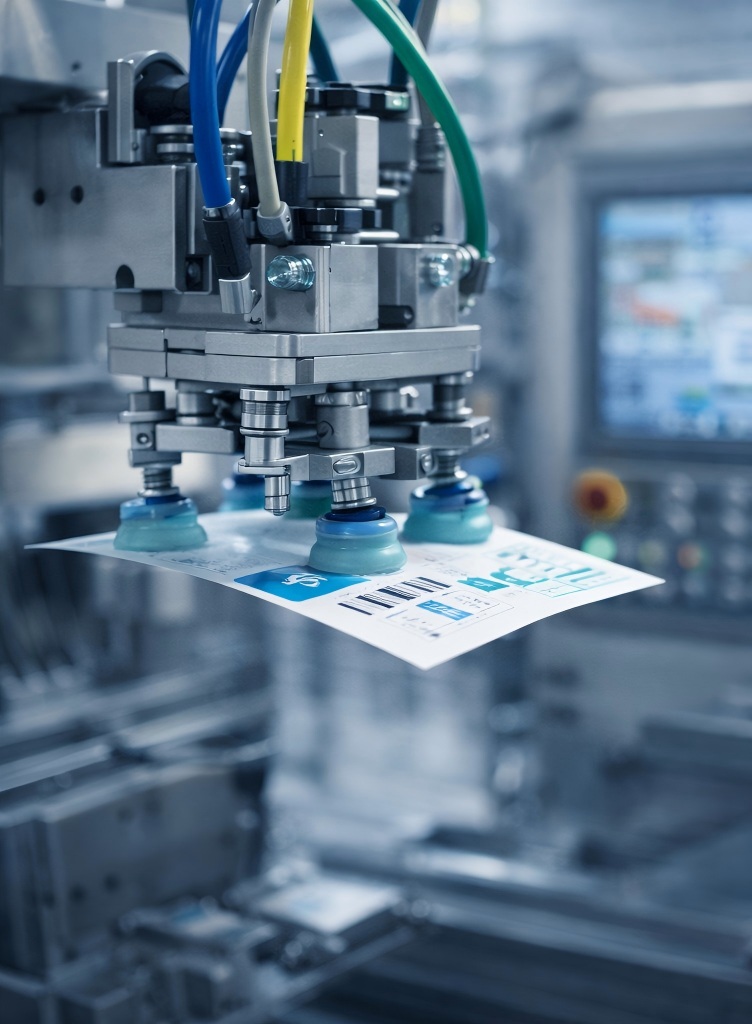
How robotic suction cup grippers achieve stable vacuum adhesion for IML labels. Explained from a label manufacturer’s perspective—materials, surface energy, static control, and automation reliability.
Mastering Vacuum Pickup in High-Speed IML: Why Labels, Not Robots, Drive Reliability
Executive Summary
In high-speed In-Mold Labeling (IML), robotic suction grippers are often praised for automation. Vacuum cups do not create reliability; they respond to the surface topography and energy of the label.
When cycle times are measured in milliseconds, pickup success is no longer a robotics problem—it becomes a label materials and surface-engineering challenge.
1. The Physics of Vacuum Adhesion in IML {#physics-of-vacuum}
Vacuum gripping relies on pressure differential, not chemical adhesion. A suction cup creates a sealed volume against the label. When air is removed, atmospheric pressure (Patm𝑃𝑎𝑡𝑚) exerts a force ( F𝐹) against the lower pressure inside the cup (Pvac𝑎𝑐).
The theoretical holding force is calculated as:
F=A * (Patm-Pvac)
Where A is the effective sealed area.
The IML Reality Check
In high-speed robotics, Vacuum Force is rarely the limiting factor. The true bottlenecks are Seal Formation Time and Air Leakage Rate.
- Seal Quality over Strength: A 90% vacuum is ineffective if the cup takes 200ms to "seat." IML prioritizes a 40% vacuum achieved in 10ms.
- Surface Energy & "Wetting": For a perfect seal, the elastomer of the suction cup must "wet" the label surface. If the label's surface energy is too low, or the surface is topographically irregular, micro-gaps remain, allowing air to bleed in and compromising the Pvac𝑎𝑐.
2. Why IML Labels Challenge Robotic End-of-Arm Tooling (EOAT) {#challenges}
IML labels present difficulties for vacuum systems:
- Non-Porous but Textured: Matte inks and coatings create micro-channels that act like tiny leaks.
- Low Surface Energy: Untreated Polypropylene (PP) is naturally "low energy," making it difficult for standard rubber cups to form an airtight molecular bond.
- Static Interference: electrostatic forces that interfere with initial cup seating and seal formation. This avoids pedantic pushback from automation engineers.
🔍 Technical Myth: Increasing vacuum flow always fixes dropped labels. Correction: High flow through a small orifice can cause the Bernoulli Effect, lifting the edges of a thin label away from the cup before the seal is made.
3. Engineering the High-Performance IML Gripping System {#system-design}
A production-grade system must be tuned to the specific substrate.
Component | IML-Specific Requirement | Why It Matters |
|---|---|---|
Cup Material | Anti-static Silicone / Nitrile | Stabilizes pickup by preventing dust attraction and charge accumulation. |
Lip Geometry | Ultra-thin, compliant lip | Enables fast sealing without label deformation |
Vacuum Source | Multi-stage Venturi Ejectors | Delivers high initial airflow for millisecond-level seal formation |
Sensors | Digital Vacuum Switches | Detects incomplete seals before robot motion |
4. How Label Design Enables Vacuum Stability {#label-engineering}
In high-speed IML, the label manufacturer becomes the primary architect of automation uptime—often more influential than the robot or EOAT supplier. To ensure 99.9% pickup reliability, the following must be controlled:
Surface Energy Engineering
Reliable pickup requires a surface energy (measured in dynes/cm) that allows the cup to achieve a "gas-tight" interface. This is managed through:
- Corona Treatment: Increasing surface polarity for better cup "wetting."
- Coating Chemistry: Ensuring overprint varnishes (OPV) aren't so "slippery" that the cup slides during high-speed lateral moves (G𝐺-force).
Ink Coverage & Topography
Heavy ink loads can change the physical thickness of the label locally. If a suction cup straddles a "heavy ink" area and a "no ink" area, the height differential can break the vacuum seal.
5. Conclusion: A System-Level Approach to IML
Vacuum pickup is a label-led system, not a robot trick. For high-yield IML automation, the vacuum system must be optimized for response time, while the label must be engineered for predictable surface energy and flatness. When a "robot" fails to pick a label, the solution is rarely a bigger pump—it’s usually a better-engineered surface.
About the Author (B2B Authority Version)
Anna | IML Label Engineering & Automation Interface SpecialistAnna works at CPP, an IML-focused label manufacturer with over 15 years of experience supporting injection molding automation worldwide. Her work sits at the intersection of label material engineering, robotic IML systems, and mold integration.Rather than treating labels as printed components, she collaborates directly with injection molders, automation integrators, and robotic EOAT suppliers to resolve system-level failures caused by surface energy imbalance, static behavior, curl memory, and pickup instability. Her focus is helping IML lines achieve repeatable automation performance through label-driven engineering decisions.